As you may have noticed, I really love fusion cuisine and the improbable but delicious flavor pairings that come into being when traditions from different parts of the world are combined. Today’s recipe is one such dish: part Italian, part American and part… Nigerian? Allow me to explain.
This summer, I had plantains on the brain because I’d recently gotten my hands on a really cool plantain cookbook – by Tomi Makanjuola, who runs the blog The Vegan Nigerian – which has over 40 recipes showcasing the underappreciated fruit in almost every kind of dish you can imagine. As I always try to make at least five recipes from every cookbook I acquire, in line with the philosophy behind my cookbook challenge, I set about making some of the dishes right away (my favorites are the beans & plantain pottage and the smoky plantain, mushroom & avocado on toast).
As I began to appreciate the humble plantain more and more, I thought it would be fun to create a plantain recipe of my own for this blog. As I set about reflecting upon savory and sweet combinations not already covered in that cookbook, Hawaiian pizza popped into my mind. Many are the opponents of pineapple on pizza, especially one Italian friend of mine, but I happen to love it. So I thought plantain might work on a pizza too as long as there was also something spicy to balance out the sweetness. After brainstorming a list of likely ingredients, I rolled up my sleeves and got to work.
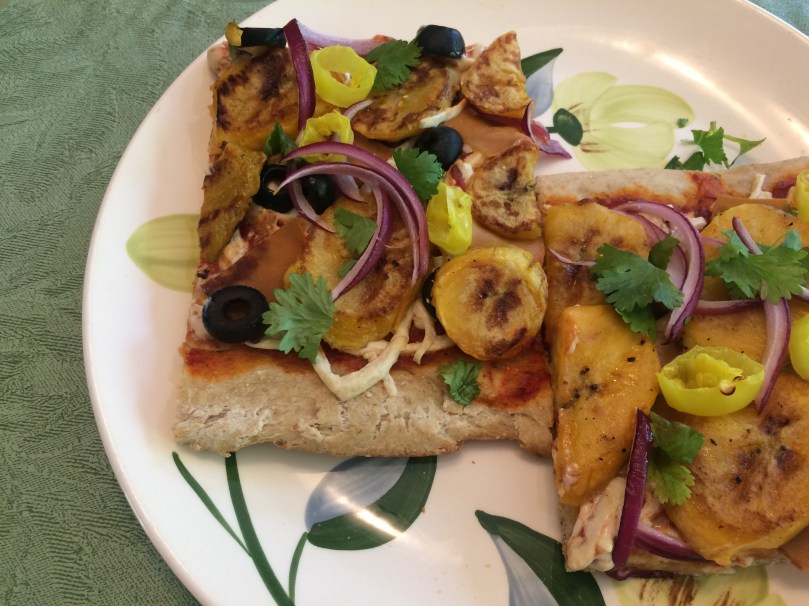
To be honest, even I was not totally sure if plantain on pizza would work out. But I looooooved it! My mom and dad did, too (I was at their house when I made it). It has smoky, savory notes from the smoked vegan deli meat, crunchy oniony-ness from the red onion, freshness from the cilantro and of course the crispy sweet plantain goodness of the star ingredient. I also love how colorful it is (red, white, yellow, purple, black, green).
So as I was saying, this pizza is a fusion dish – pizza has its origins in Naples but was developed into the dish we know today in early 20th century New York City (listen to this interesting How to Be American podcast episode for more on that) and this particular one has a key ingredient that’s grown in Nigeria, but also other parts of Africa as well as Asia and Latin America. Plantain is therefore not a specifically Nigerian thing, but since a Nigerian cookbook author inspired me to create this dish, I’ve associated it that way in my mind.
If all this has intrigued you and you want to try making it too, read on!
A note about the crust: when I made this pizza, I used an overly complicated homemade pizza dough recipe that I wouldn’t recommend, so I’ll leave it to you to find one you like. It just needs to be thick or firm enough to support the rather hefty plantain slices.
Plantain pizza
Makes an approximately 12-inch (30-cm) pizza
one thickish (but not deep-dish) pizza crust, purchased or homemade
5 to 6 tablespoons pizza sauce (or tomato sauce plus Italian herbs)
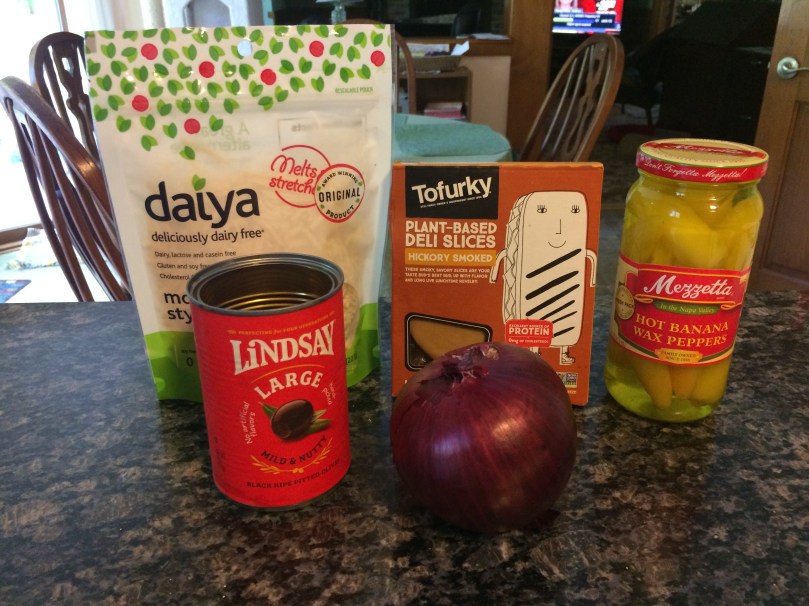
3/4 cup (75 g) mozzarella-style vegan cheese (optional)
2 to 3 vegan deli-style smoked “meat” slices
1 to 2 medium-ripe plantains
1/2 cup (60 g) red onion
1/4 cup (30 g) sliced black olives
1/3 cup sliced canned banana, peperoncino or other hot pepper
small bunch fresh cilantro (coriander)
2 tablespoons cornmeal, for pan (or use baking paper)
Preheat your oven to 475°F (250°C) and begin by preparing the plantains. Slice each one lengthwise and remove the peel. Slice into rounds of equal thickness, about 1/4th of an inch (5 mm) thick, and sauté on both sides over medium heat until golden brown. It’s important for the plantain to be fully precooked as undercooked plantain can lead to tummyache, and the time it spends in the oven might not be enough.
Sprinkle your baking sheet with the cornmeal to prevent sticking or, alternatively, line with baking paper. Place the dough upon it, rolling it flat if needed – mine was rectangular and measured 10.5 x 12.5 inches (27 x 32 cm) before baking. Spread the pizza sauce on it evenly, using more than the recommended amount if necessary or desired. Cover that with the vegan mozzarella, if using (I recommend Daiya in North America or Violife in Europe). But you can also opt not to use any cheese at all. If you don’t use cheese, a sprinkling of nutritional yeast before or after baking will add a somewhat cheesy flavor.
Cut the smoky vegan deli “meat” slices into squares. Use however much you like.
Slice your red onion (and black olives, if not presliced) and place on top of the pizza.
Finally, slice up the hot peppers and place on top of the pizza in the amount that you like, depending how partial you are. I started with two peppers but ended up adding some more after the pizza came out of the oven as I really loved the combination.
Place in the oven (preheated to 475°F/250°C) and bake for about 10 minutes. Keep an eye on things because baking times can vary quite a bit depending on the thickness of your particular crust. If after 10 minutes it doesn’t seem done, give it some more time.
Remove from the oven and garnish with fresh cilantro (coriander) leaves. Your one-of-a-kind plantain pizza is ready! Slice it up and serve it to your hungry guests (…or yourself!).
By the way, what do you think of the tablecloth? An uncle of mine brought it from Liberia as a gift for my parents some years ago, and I thought it would fit well with this recipe’s West African theme.
Soooo yummy, if I do say so myself! I want to make it again. 🙂
Where to find ingredients…
Plantains can be found at most supermarkets, but if you don’t find any, look for a Latin-American, African or Asian grocery.
Mozzarella-style vegan cheese is increasingly available at mainstream grocery stores in North America, but organic shops are even more likely to have it. In France, you’ll find it at some organic shops, but for best results check at a vegan food shop first (in Paris: Naturalia Vegan, Mon Epicerie Paris and Aujourd’hui Demain).
Vegan deli “meat” slices will also most likely be found at organic and vegan food shops. In Europe, I recommend the brand Wheaty.
In 2019, I was lucky enough to happen upon several really, really good books. And this month I decided to revisit an idea from January 2017 and tell you all about my favorite books from the past year.
I also started a new challenge in 2019. You know those “100 books to read before you die” lists that pop up from time to time, full of classics from world literature? This summer I stumbled upon yet another one and, as always, felt frustrated that I’d read relatively few of them. So I decided to correct this and made my own “bucket” list of 250 titles using the recommendations from this site, which offers a list generated from 128 best books lists. I went with 250 books rather than just 100 because I’d already read some in the 100-250 range and figured expanding the list couldn’t hurt. So far, counting the ones I’d already read, I have 55 of the 250 under my belt. Finishing the entire list will be the work of many years, but chipping away at this challenge makes me feel accomplished. And of course, I may just discover favorite new books and authors this way.
I also copied down The Guardian’s list of the 100 best novels written in English to be sure not to neglect any of those (I’ve read 25 so far), although there’s a lot of overlap between the two lists. And finally, I’m still working on my Read the World challenge with the goal of eventually reading at least one novel (any novel) from every country. So far, I’ve covered only 32 of the 196, but it’s a start.
So which of the books that I read in 2019 did I like the most? Read on to find out.
Heaven and Hell (2007) by Jón Kalman Stefánsson
Of all the novels I’ve ever stumbled upon randomly, I think this one is my most valuable find. I was on my way home from a grocery store when I noticed a pile of abandoned books on a ledge and couldn’t resist stopping to check them out in spite of the surplus I already had at home. Seeing one by an Icelandic author (and being a big fan of Iceland), I decided to take it. It wasn’t long before I realized how lucky I was it had crossed my path. Heaven and Hell is about a young fisherman in a remote part of Iceland 100 years ago. As his real passion is not fish but words, he is sadly ill-suited to his job. Soon enough, tragedy strikes, prompting him to leave the crew to fulfill a special mission.
This story immerses you not just in another world and another time, but in a special realm of magic where you hear the thoughts of fish sighing in the depths of the fjords, peer into the labyrinth of the human soul and learn that you can hear the stars sing if you only climb high enough into the mountains. Narrative – and opinions – from a chorus of unidentified dead fisherman sometimes finds its way between the chapters. Although the novel is actually the first in a trilogy, it can also stand fairly well on its own. And if you become captivated by these characters, as I did, you’ll be glad there’s more to come. As I type these words, I’m halfway through the third volume,The Heart of Man, and am loving it.
The copy of Heaven and Hell that I happened upon is the French translation (Entre ciel et terre) by Éric Boury, whom I greatly respect as his version seems to have touched the hearts of this readership just as effectively as the original has with the author’s compatriots. And as the English version by Philip Roughton also has stellar reviews, I will not hesitate to recommend both here.
Madame Bovary (1856) by Gustave Flaubert
If it hadn’t been for that “best books” challenge, I probably wouldn’t have picked this one up for a while. But it was more enjoyable than I expected, and I now regret waiting so long to read anything by Flaubert. Essentially a parable about the perils of ambition, Madame Bovary makes its points through the sad tale of the anti-heroine and also some minor characters.
Perpetually dissatisfied, Emma Bovary has made the mistake of marrying a boring country doctor and they live decidedly too far away from the excitements of cities and society life for her liking. Although this story was written in the 19th century, its moral is still highly relevant today and, human nature being what it is, will probably remain so.
I read this novel in the original French on Kindle (hooray for the public domain!) and as a side benefit, learned the French names of obsolete objects such as the buvard (ink blotting paper) Emma uses when penning her many letters to a certain rascally someone – you’ll have to read it yourself to find out who!
After finishing the book, I was excited to find a recent English-language film adaptation by Sophie Barthes, starring Mia Wasikowska, on Netflix. Sadly, it proved highly forgettable, and I couldn’t get past the fact that some actors spoke with British accents while others had American ones, and all the characters were of course all supposed to be from the same country (just pick one accent!).
Song of Solomon (1977) by Toni Morrison
This novel was in the “best book” list too, but I would have read it anyway as I love Toni Morrison (who sadly left us this past year). During a visit home this summer, I found a copy of it in my mom’s bookshelf and dove in.
Song of Solomon follows the story of the oddly named Milkman Dead and his even odder family. As he comes of age and tries to make his way in the world, he discovers secrets about his mother and father that drive him on a quest to learn more.
The story, which draws in part upon African-American mythology, seems at first to meander, introducing various eccentric characters that don’t seem to have much to connect them. But as you read on, you piece together the rich tapestry of their shared history and destinies that intertwine no matter how hard the people try to keep their distance. As always, Morrison’s beautiful prose shone and I had trouble putting the book down. The copy I read was from the 80s and its cover informed me it had been named the best book of 1977. It’s easy to see why!
Blond(e) Boy, Red Lipstick (2018) by Geoff Bunn
This one came to my attention through the recommendation of a translator friend with good taste in literature.
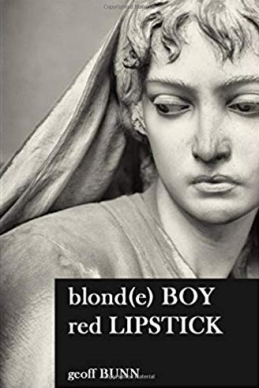
Set in London and Birmingham in the 1980s, Blond(e) Boy, Red Lipstick is a transgender romance, the first I’ve ever read. I was intrigued to find out how the main character, a young heterosexual man, ends up falling in love with a girl who turns out to be a boy. But the main thing that comes through in this story is the universality of human emotions. No matter who you are, and who you love, you’ll recognize the feelings the unnamed protagonist experiences.
And perhaps also those small points in time where, Sliding Doors style, a choice can change your whole future. The times, too, when life seems inexplicably to pave a way for you along a certain path. As the protagonist observes, “There are moments in life that are given to us.” On a side note, I can easily imagine this as a film, with an early 80s aesthetic and a great soundtrack!
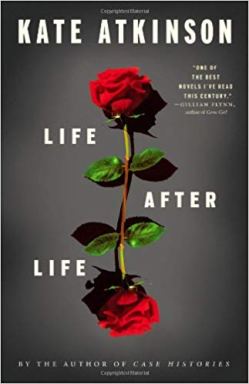
Life after Life (2013) by Kate Atkinson
What if you could live again and again, until you got it right? Such is the premise of Life after Life, an exceptional story, which follows Ursula Todd through a myriad of attempts at life. Tragedies occur, mistakes are made, and she dies at various points in her existence. Each time, she is born again as the same person, to the same family, under (roughly) the same circumstances, and repeats the same life. When she reaches the moment that saw her die the last time, she instinctively avoids the situation or takes a different action that leads to her going on living.
Watching her do this, you come to realize the enormous impact one small choice, one resolute decision, one failure to act can have. It made me reflect upon many times in my past when I should have done something different. How would things be now if I had? It also reminds you that a chain of events lies behind anyone’s situation in life, bad or good.
Another thought that may strike the reader… what if this were how life actually works? Could it be the explanation for déjà vu? We can’t prove it either way, but what would you change if you were going to live your life over again?
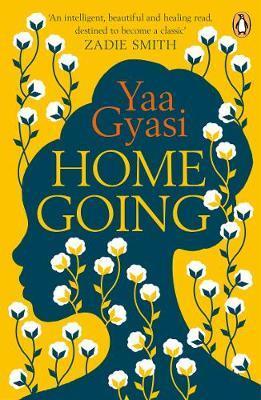
Homegoing (2017) by Yaa Gyasi
This novel was another somewhat random find. I was at one of my favorite libraries, browsing through its fairly extensive foreign-books section (this is why it’s a favorite library), and it was propped up on a display stand. I’d never heard of the author, but the endorsement by Zadie Smith was enough for me. Homegoing was a fortuitous find, for this is a gem of a book.
The story begins in 18th century Ghana, with two half-sisters who are each unaware of the other’s existence. The choices they make – or that are made for them – take them down very different paths. Effia becomes an English slave trader’s bride and lives with him in a castle while Esi is enslaved and sent to work at a plantation in the American south.
The story follows the descendants of each sister, their fates inescapably linked to that original diverging point, up to the present day. Each chapter is one person’s story. We see what life was like over the centuries in Ghana and also how Esi’s children and grandchildren fared under slavery and then in a country marked by slavery’s heavy legacy.
Informative and beautifully written, this novel is all the more impressive for being the author’s debut novel. My only complaint was that I wanted it to be longer!
All the Light We Cannot See (2014) by Anthony Doerr
I found this novel at the same library, but it had been recommended to me by a few people. All the Light We Cannot See is the touching story of a blind French girl and an orphaned German boy whose fates intersect during World War II. The girl flees with her father from Paris to the walled city of Saint-Malo, where they try to survive alongside an eccentric uncle and scheming neighbors. The boy, meanwhile, becomes a Nazi soldier through no particular decision of his own and takes some time to make up his own mind about what it is that he’s participating in.
With sight and the invisible as a theme, the novel focuses among other things on the various ways people react to crisis, making choices that protect their own interests but hurt others or, inversely, help others but cause their own downfall or even demise. The consequences, of course, are often invisible at the time of choosing.
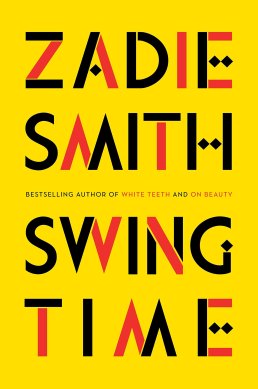
Swing Time (2016) by Zadie Smith
As the title suggests, dance and performance is a major theme of this story, which revolves around the complicated friendship of two girls growing up in a low-income neighborhood of northwest London. One has talent but faces obstacles, while the other has dreams without the corresponding skills and eventually finds herself taking another path.
The part of the novel set in Africa is what interested me most. A mega-rich, mega-popular American pop star decides to open a school for girls in an underprivileged rural area of an unnamed African country. But when the best of intentions, cultural ignorance and too much money coincide, things don’t always go as planned.
The various storylines in this novel can sometimes feel disconnected and disjointed, but isn’t that kind of how real life works too? I found this novel very entertaining in spite of it all.
Honorable mentions
Here are a few more that I read in 2019, but that I don’t recommend unreservedly.
Orlando (1928) by Virginia Woolf. Although I enjoy Woolf’s writing overall, her stream-of-consciousness style can make getting through her books somewhat of an arduous task. But Orlando is an important work in the history of literature, both for feminism and transgender topics (it is the first English-language trans novel). In this novel, which spans three centuries and relies on a good dose of magical realism, the titular protagonist has adventures in several countries and undergoes a spontaneous sex change midway through. Woolf’s friend and lover Vita Sackville-West was the direct inspiration for the character, so reading this novel is a good way to gain a better understanding of both authors and their writing. But reading Orlando is not a thankless task – it does demand work on the reader’s end but there are many rewards along the way, moments of pure comedy and biting insights into patriarchy’s various unfairnesses. Watching Sally Potter’s beautiful 1993 film adaptation (starring Tilda Swinton and a cross-dressing Quentin Crisp) could be a good way to get started on this book, which does however have a lot more content than what could be covered in the film.
At the Strangers’ Gate (2017) by Adam Gopnik. This memoir of the author’s early days in New York City was one of my Paris sidewalk finds, and since I knew his name already from his Paris book (which I haven’t read yet), I took a chance on it. Alas, there’s a certain tediousness in his style. I can’t quite put my finger on what’s wrong, since he’s clearly a skilled writer, but it may have something to do with his love of aphorism. Or maybe you have to be more interested in his life and the celebrity friends he talks about. Still, I enjoyed two chapters of At the Strangers’ Gate and recommend them to anyone who writes for a living (copywriters, editors, translators). The first one is chapter 6, “The Simple Logic of Summer Shirts,” in which Gopnik recounts his time working as a fashion copyeditor for the magazine GQ in the 80s: “The rhetoric of fashion – even men’s fashion – in those days, as probably in these days, too, depended on a simple, puzzlingly repeated tale of previous confusion from which we had now blessedly – just this month! – recovered.” I recognized this rhetoric, which is definitely still a thing, from my fairly limited experience translating for fashion brands. And in chapter 9, “Writing,” he talks about his work for a publisher, offering up more tidbits on publishing that could be useful or interesting to the categories of people I mentioned above. And who knows, maybe you’ll like the rest of the book more than I did.
Can’t and Won’t (2017) by Lydia Davis. The first work in the genre of flash fiction that I’ve ever read, Can’t and Won’t was full of fun little gems, pithy observations on everyday life that anyone can probably relate to. Some were very very short, consisting of just one sentence, like “Sitting with My Little Friend” (“Sitting with my little friend on the front/step:/I am reading a book by Blanchot/and she is licking her leg.”). Other longer ones offered a dry humor that I appreciated – like when the author and her neighbor both become paralyzed with indecision over a throw rug, or when the author receives a box of chocolates and cannot decide who should eat them and when. My favorite piece was a letter the author purportedly sent to a green pea manufacturer to complain about the package images and suggest improvements (it’s the kind of letter I often contemplate writing when I encounter bad translations on packaging or restaurant menus, but never do). Davis happens to also be a French to English translator, like myself, and has produced new translations of some of Flaubert’s work (after reading the original Madame Bovary this year, I now want to check out her version). And this collection of stories includes some rather experimental pieces drawn in part from Flaubert’s correspondence. But they aren’t straightforward translations – rather, she starts with one of his letters but sometimes embellishes upon it or combines it with something from another of his letters. The result is generally an amusing anecdote, although it is a bit frustrating to not know how much of it is Flaubert and how much Davis. In any case, although I enjoyed this book I didn’t include it in my main list of recommendations because flash fiction is a genre with many detractors (especially judging from the Goodreads comments), so this type of writing may not be for everyone.
How about you? What good books did you read this past year? What are your favorites of all time? Let us know in the comments.
In any case, I hope some of my favorite reads will inspire you too. And for more ideas, be sure to also check out my best reads list from 2016. Happy reading, fellow bookworms!
Quite a few books out there offer to teach you how to do X, Y or Z like the French, since imitating them, according to a certain line of thought, is the surest way to secure success for yourself in this life. But today’s post isn’t about how this nation can inspire us to dress more fashionably, eat gourmet food without getting fat or raise better behaved children. It’s about how to actually become French, in the most literal way possible. Like Josephine Baker did, in 1937, when she became a citizen.
One of the most successful entertainers of the Jazz Age, Baker was born in St. Louis, Missouri but fell in love with France when she first visited in 1925 at the age of 19. It wasn’t long before she made it her permanent home.
This past year, it was my turn! After 10 years of living and working in France, becoming (reasonably) integrated into French society and my identity fusing into a combination of American and French/European, I became a naturalized French citizen.
It happened in May but became more and more official in various stages and still feels rather surreal to me. Especially when I think about how I’d always been a descendant of immigrants – on one side of the family, my ancestors came to the US from Germany four generations ago and on the other side a bit earlier – but am now the immigrant myself, a first-generation one. In hyphenated speak, I was a European-American but now am (also) an American-European.
Because both the US and France allow multiple nationalities, I’ve kept my original one too (in fact, ditching it is complex and difficult), so I’m a dual citizen and can vote in both countries. For people from places like Japan, Djibouti, India and China that officially allow only one nationality, applying for a new one is a much bigger decision. I probably wouldn’t have done it if it meant giving up my US citizenship.
But why go to the trouble, some may wonder. What difference does it make? Well, in addition to the ability to vote in French and EU elections, having the French nationality means I no longer have to renew a residence permit every few years, and wonder each time if I’ll be successful. In fact, as you’ll read in more detail below, if I hadn’t applied for citizenship when I did, I would have found myself with no way to stay in France by the end of 2018. And it also allows me to work in whatever sector I feel like (even in the government), whereas my residence permits were tied to my work as a translator and obliged me to stick with something related to translation. And finally, as an EU citizen, I can live wherever I choose within the EU and also the European Free Trade Association countries (Iceland, Norway and Liechtenstein).
If you too want to apply for French citizenship, or are just curious about the process, read on! A word of caution: definitely do not rely solely on the information below because rules and requirements can and do change constantly – some of what applied in my case is already obsolete. And if you’re not in Paris, things happen a lot faster.
First, here’s a timeline of my process:
April 2009: moved to France with the three-year Carte compétences et talents residence permit (renewed in 2012 and 2015), continued working as a freelance translator through my US-based sole proprietorship Early 2012: switched to a French small business (for the same work) and therefore began paying taxes in France instead of the US Early 2017: after paying taxes in France for five years, was eligible to apply for citizenship and began putting an application dossier together May 2017: submitted my application for the first time September 2017: application was returned to me as incomplete, with a request to provide additional documents that had not originally been requested November 2017: submitted my application for the second time (getting the missing documents and having them translated took a while) August 2018: received appointment for my naturalization interview, two months ahead of time (this is unusually long) October 2018: had my naturalization interview, answered 99% of the questions correctly Four weeks later: did not receive a rejection letter (this meant I’d been approved) May 2019: received the letter from the Ministry of the Interior informing me I was henceforth a French citizen June 2019: applied for and received my new passport and national ID card October 2019: attended my citizenship ceremony (invitation received two weeks ahead) December 2019: attended a special event at the Hôtel de Ville given by Anne Hidalgo, the mayor of Paris, for people naturalized in 2019 January 2020: will attend a similar event at the town hall of my arrondissement
Things to know for a successful outcome
Knowledge is power
In spite of my best efforts, some necessary documents (not on the list the naturalization office gave me) were missing from my dossier the first time I submitted it. It took them four months to tell me this and two more months for me to obtain the requested items, so that made the whole process take six months longer. This could have been avoided if I’d only been communicating with others who were also applying for naturalization or simply been aware of the dedicated Facebook groups – Naturalisation (retour d’expérience) is a very good source of information. Even if you think you’re on top of everything, spend some time reading the archives – you might just learn something that saves you a year of waiting, or even makes or breaks your case.
Application
In Paris, you can get an application by stopping by the naturalization office on Ile de la Cité. I recommend doing this rather than simply downloading it because you can also ask the counter person which documents you – with your particular circumstances – need to provide. Asking in person is really the only way to get an answer, as phone calls tend to not get through.
However, since the answers you get aren’t always fully accurate, be sure to also read about other people’s experiences and ask for info as needed (see previous section). The application needs to be filled out in duplicate.
ID photos
With your application, you need to include a few copies of an ID photo. Note that this isn’t the same photo that will be used for your French national ID card and passport, if you’re successful. For that, at the end of the whole 18+ month process, you’re supposed to provide a current one (taken within the past six months, but no proof of the date is required). So if you really like the photo you submit with your application, be sure to hold on to one copy of it to use again later.
Active involvement in French society
Anyone considering applying for the nationality would do well to become a member of a local association, nonprofit or club of some kind years ahead of time. Note that for the naturalization office, simply donating money to a cause does not count as involvement; you need to be an official member of something and have proof of your active involvement in it. You want to show that you’re not just hanging out exclusively with people from your own country, speaking your native language, but are part of the larger society.
In my case, years before naturalization was even really on my radar, I got involved in some local animal-protection nonprofits as a volunteer translator and in other capacities. In particular, I wrote several articles in French for the magazine published by the Association végétarienne de France (a local vegan society). I did this out of genuine interest and dedication to the cause, but later discovered that it was also an asset for my naturalization application since it was evidence of my integration and ability to use the French language.
French language exam
This is a part of the process I was actually looking forward to, as I’d never had my French-language skills formally evaluated (outside of classes that is), not having ever needed to take the DELF or DALF exam. I mean, I knew I could more or less hold my own in French but wasn’t sure if official test-giving people would agree.
The Test de connaissance du français pour l’accès à la nationalité française (TCF ANF) is specifically designed for people who are applying to become French citizens and as such, focuses on listening and speaking abilities [NOTE: going on their site just now, I learned that people taking the test in April 2020 or later will also have to do some writing components]. It’s offered at various language schools and you take it at some point prior to submitting your naturalization application, since the official test results transcript is one of the documents you must include. There’s no real way to prepare for it – you either have the skills already or you don’t. Since I knew my level was decent, I wasn’t nervous about taking this test.
The first part was a multiple-choice listening test, which did make me panic a bit once it started as it was harder than I’d expected. There were 25 short recordings, each played only once without much time between questions and the room was echoey. One was of a person calling in to a radio show, so you can imagine the sound quality of that.
For the second part, each person in our small group of test-takers went into another room with a facilitator, one by one, to prove their speaking skills. This involved a role-play conversation about a hypothetical daily-life situation (advising a friend who has noisy neighbors) and then choosing and arguing for a position on some assigned topic (“should we or shouldn’t we teach children about the dangers of the Internet?”). Each person was given different prompts. This part of the test was no problem for me, and I even got a bit carried away in my response to the last prompt, wanting to continue making my points even when the woman told me I could stop.
I’m happy to report that my results were good. I got 100% on the speaking part and one question wrong on the listening part (I’ll never know which one). The scores range from A1 at the lowest and C2 at the highest, and to be eligible to apply for citizenship you need at least a B1 level.
Since the results of this test actually have an expiration date, I recommend taking it only at the end of your application-preparation process, just before applying.
Parents’ documents, apostilles and translations
The application asks for information not just about you but about your parents, siblings, children and even past spouse(s) if you’re divorced or widowed. You’re also supposed to list every single address you’ve ever lived at in your entire life (!) along with dates, and I was amazingly able to do this accurately with the help of my dad, who for some reason had kept a record of all the places our family has lived. The same goes for all the jobs you’ve ever had, though I suppose they don’t place too much importance on the fast-food places you worked at when you were in high school, so there’s no reason to get too stressed. Just use your best judgment as far as what to include, and focus on post university positions.
You must furthermore provide your parents’ birth certificates in addition to your own, or just their marriage certificate if (and only if) said certificate states their places and dates of birth. I learned the hard way that this last detail was what mattered! It’s because when you become naturalized, you’re actually issued a French birth certificate (!) listing the places and dates of birth of your parents in addition to your own. As I didn’t realize this at first, I submitted only their marriage certificate and then had to later urgently procure their birth certificates and have them translated since those details were missing and nobody was about to take my word for them. And yes, don’t forget about the translations. Everything you submit with your dossier has to be translated into French by a traducteur assermenté (translator with “sworn” status in France). You will probably also have to get what’s called an apostillefor each of these documents, and then have the apostilles translated (it just keeps getting better). Learn from my mistakes, save yourself time and trouble and request the apostille at the same time as the certificate.
Police record
If you’ve lived in France less than 10 years at the time of your application, you will also need to provide a casier judiciaire (police record) from all the countries you lived in within that same period of time. If you’re from the US, this takes the form of an FBI report, which involves having your fingerprints taken, mailing them in and then waiting forever for the result. The result, and an apostille of same, then needs to be translated.
New French name?
When you gain the French nationality, you have the option of changing your name (first and/or last) to something French. Most people opt not to, but you could for example just change a spelling (Mary to Marie) or insert an accent mark (Josephine to Joséphine). Or give yourself the gift of an extra middle name. In France, it’s common to have two or more middle names, so if you have only one, this is your chance to add some extra flair to your life (sadly, I didn’t think of doing this until it was too late). Reflect upon this well ahead of time because you’re supposed to put the new name on your application form. Once the naturalization is complete it becomes much harder to change.
When in doubt, go overboard
Not totally sure if you need to add that document? Add it anyway! It’s best to err on the side of too much rather than too little, since missing documents will mean more delays and hassle (I had a six-month delay because of this). I included a cover letter and apostilles for everything, even though apostilles had been explicitly requested for only certain documents, because someone else further down along the line could have randomly decided that they were needed after all. And if you’ve lived in France for any time, you’ll know what I mean about those random spontaneous rule changes.
Actually applying
When you finally have everything together, put it in a very secure envelope and mail it en recommandée avec accusé de réception (via registered mail with proof of receipt). You’ll get this proof of receipt back in a few days.
While you wait
You now have eight or nine months of waiting until the next step in the process – the naturalization interview, in which you’re quizzed on your knowledge of French history and facts and asked why you want to be a French citizen.
I recommend using this time to read and start memorizing the Livret du citoyen (French citizens’ handbook), which can be found online in PDF form. It covers all the key dates, people and facts of French history, as well as some things about the legislative system. You’ll need to know the information in it (and more) like the back of your hand for your interview. Don’t forget to also study up on the European Union, because you’re trying to become not just a citizen of France but of the EU too, and there will be questions on both.
The Facebook group I linked to above is a great place to learn the questions that are often asked. Also search online for other message forums or blog posts with the keywords entretien de naturalisation. I personally relied heavily on the list in this very useful blog post, and some English-language blogs (like this one) were helpful too. If you speak another language, check for information in that one too.
I began by making paper flash cards based on the information in the Livret plus the questions other people have had. But I soon switched to the flash-card app Anki and that turned out to be a really good way to study – you can create your own set of cards and have the app take you through them randomly, showing you one side and then letting you flip to the other side to check the answer. I created mine in French, the language of the interview, and spent a LOT of time going through them, rehearsing my answer before flipping to the back of each card, and then repeating, repeating, repeating until I could have answered them in my sleep or given a 30-minute lecture on the history of France at a moment’s notice. Since they were on my phone, I could study them in the metro, in line at the supermarket – basically, anywhere and anytime, including in the waiting room just before my interview.
Also check out the very cute video series Les Clés de la République for a fun way to learn all about France’s government, laws, values, symbols etc. (just about all the things you need to know for the interview).
But your answer to “Why do you want to be French?” is probably most important of all, so make sure you think this through and have something to say. In my preparations, I happened upon a horror story from someone who wasn’t ready for this question – don’t let that happen to you!
In any case, start preparing for the interview early because when the letter summoning you to it comes, you may not have much advance notice (it could be just a week or two ahead of time). Furthermore, the letter will contain a list of additional documents to bring, and tracking them down will take a while too, leaving you with precious little time to study. This is why it’s key to do what you can while you still have time. For example, begin creating your flashcards even if you won’t be studying them right away.
Among other things, you should also be able to identify and explain the significance of all the people, place and things in the images of this post, so maybe start with that! 😉
Keep your residence permit current
If, during this waiting period, your residence permit will expire, make sure to apply for anew one well ahead of time (I believe six to four months ahead is the recommendation). If you haven’t applied, this can become an obstacle to getting the citizenship even if all your other ducks are in a row. As luck would have it, mine was expiring one month after my naturalization interview, and with everything that had been going on I hadn’t yet begun applying for a new permit. This is mainly because the type of permit I’d had (the Carte compétences et talents) had been done away with and “replaced” by the Passeport talent, a permit with new specific criteria I didn’t quite meet, and I was at a loss as to what else I could apply for. The residence permit office refused to advise me on my options.
But given the urgency of the situation (my application could not be forwarded to the next step until I supplied proof of having an appointment with the residence permit people), I applied for the Passeport talent anyway. And I was rejected! So if I hadn’t already applied for the nationality I might have had to leave France. In a dramatic turn of events worthy of a Hollywood film, I received the Passeport talent rejection letter just one day before learning I had been naturalized.
The interview
For many, the naturalization interview is the most dreaded part of the whole process, but if you’re properly prepared it’s not bad at all.
The lady who interviewed me was friendly and kind, and this is the case with most interviewers, from what I’ve heard. We spent the first half of the hour going through my paperwork and figuring out if I had all the documents I was supposed to. As it turned out, I didn’t, thanks in part to the vagueness of the list of things to bring in the summons letter and the impossibility of contacting anyone for clarification (the email I sent to the address provided bounced – it turned out they gave me the wrong address). Fortunately, she was very forgiving about this and allowed me to send the missing documents later that day.
Then it was time for the questions. One thing that put me at ease was that she wasn’t staring at me while I answered, like they do in job interviews to see how quickly you become unnerved, but settled herself in front of her computer, though still facing me, and types my responses as we went along.
She started with some questions about me, such as how often I go back to my home country, whether my friends are mostly French or from my country (note: there’s only one correct way to answer this) and who in my family still lives in the US. She asked if I belonged to an association, at which point I pulled out some Association végétarienne de France magazines with my articles in them and explained about that. I’d been kind of worried the vegetarian thing would work against me, France still being mostly hostile to such things, but the lady just made a joke about dieting (“Tous au régime, hein ?”) and that seemed to be the extent of her reaction. She took a magazine to look at later.
Next, she checked my knowledge of France, prompting me to explain what I knew about the national holiday (what day of the year, what for, and everything else related to the French Revolution) and France’s symbols and values (liberté, égalité, fraternité and laïcité for good measure). She then asked me to explain what I knew about the last one, including the related laws and regulations and their dates. As I answered, I noticed her nodding each time I correctly explained one of the key facts. I could almost hear a pinball machine dinging as we went along, pushing my score higher and higher.
From that we moved on to the European Union, and there were only two questions: how many member states there are and what year the treaty on the euro was signed. I knew the first one but began to sweat over the second one, since I’d studied only the Treaty of Rome and the history of the EU’s formation. I answered something about how France got the physical currency in 2002 but had begun using it in virtual transactions a bit earlier, in 2000 (wrong – it was 1999), but what she really wanted was for me to name the Maastricht Treaty and give its date (1992). This was the only question I couldn’t fully answer though, so I guess it didn’t count against me too much.
And finally… why did I want to become French?
I started by saying that France, French culture and the French language had been part of my life since middle school and that I’d never stopped learning about them. And that I’d been here for nearly 10 years and really felt that I’d integrated France into my identity – for example, when France has a victory of some kind (like the World Cup win), I feel proud. She nodded enthusiastically as I said all of this.
I then went on to say that I believed in France’s values. I named them all again and said I particularly appreciated the fraternity/solidarity that exists here in France, the fact that people generally want to help each other (in particular by contributing to social security for the benefit of all), and that I felt better having my tax money go to France and help fund French social security than to the US where there is no such spirit (again, all very true). “As you may know,” I continued, the passion rising in my voice, “there are lots of people in my country who are against universal healthcare, and I simply cannot understand that.” By this point in my rant the lady was nodding her head even more vigorously in agreement and deploring the situation in the US, so I went ahead and added that as I saw it, many things happening in the US were a shame and a disaster, etc. (which they are) and she completely agreed. I drove the point home by saying I was proud to contribute to French social security and to be part of this system of solidarity (which I am).
At this point I felt I had been approved. The lady politely cut my speech short, quizzed me briefly on the rights and duties of a French citizen (pay taxes, help defend the country at times of war, vote) and then hurriedly ended our chat as she was running behind and had more foreigners to interview. I was a bit disappointed I didn’t get a chance to amaze her with my knowledge of presidents, kings, world wars, rivers and mountain ranges, overseas territories, authors, artists, novels, films and the short-lived but fascinating revolutionary calendar (1793-1805), but when walking out of a naturalization interview that seems to have gone well, one can hardly complain about such things.
No news is good news
Once your interview has happened, they actually make their decision really quickly, in the next three to four weeks. If your application is turned down, you receive a letter by registered mail within four weeks. If after four weeks you’ve received nothing, you know you’ve probably been accepted and citizenship is on its way! But for some reason (in Paris at least) it takes another six months for it to become official.
Journal officiel and letter
When you do finally become a citizen, your name is published in the Journal officiel (JO), a sort of online governmental bulletin where new laws and rulings are announced and that nobody reads. Accessing it is a bit complex, but this link will take you to the naturalization decrees. The JO listing is how I first learned I’d become French, and then I received the official letter from the Ministry of the Interior a week or so later – an exciting moment even when you know it’s coming. In some cases people don’t get the letter for a long while, so it can be handy to keep an eye on the JO.
National ID card and new passport
After you’ve received this golden-ticket letter, you can make an appointment at a police station to request the French national ID card and passport. I used my new passport for the first time upon returning this past September after a visit home (or should I now say “original home”?). And let me tell you, getting to stand in the much shorter “EU passports only” line at the airport border control was a triumphant moment indeed!
Naturalization ceremony
I was naturalized at the end of May, but the ceremony didn’t happen until mid-October (I assume none are held in the summer, when the whole country shuts down for vacation). It was fairly anti-climactic. Prior to applying for the citizenship, I’d heard a rumor that the ceremony was held at the Panthéon, which would have made it a very grand affair, but mine (like those of my friends) was held at the same nondescript office on Ile de la Cité where I’d picked up the application and had my interview. It’s possible that a few select ceremonies are actually held at the Panthéon but I can’t imagine under what circumstances – if someone famous is getting naturalized? If the foreign media is around?
The letter doesn’t say this, but you can bring a guest with you. I didn’t (most people didn’t), but if you have some family around I imagine it’s nice to have them there.
The ceremony is however rather… “automated”? You wait in line outside, show your papers, shuffle up the stairs with the rest of the herd and then get corralled into a long, narrow room called the Salle Marianne. An apt name, I suppose, as you come out of it more French than ever. The event lasts just 30 minutes. First, they hand you a personalized folder containing a welcome letter, the lyrics to the French national anthem La Marseillaise, your new French birth certificate and all birth certificates (yours, your parents’) that you supplied with your application. I didn’t get that magazine back, but that’s just as well as my bookshelves were already bursting.
Next, they show a short film reminding you of your rights and responsibilities as a citizen. A civil servant of some kind then gives a short speech along the same lines, and finally everyone sings a few verses of La Marseillaise together. And that’s it! We were given a few minutes to have our picture taken next to the Marianne statue, if we wanted, and to write something in a sort of guest book.
There were about 70 of us, and we weren’t allowed to linger very long in the Mariannizing room because there was another throng of people waiting outside for the next ceremony. I don’t know if there were still other groups that day, but the ceremony is held every Thursday so it seems a whole lot of people are becoming French citizens.
Reception at the Hôtel de Ville with the mayor
I’d thought the ceremony in October was the end of it, but in early December, to my surprise, Mayor Anne Hidalgo herself invited me (well, her name was on the envelope) to a special event at the Hôtel de Ville, the main city hall of Paris. It seemed to be for all the people who’d been naturalized in 2019, but not for those who’d gained the citizenship through marriage (acquisition de la nationalité par déclaration, technically not naturalization) because a friend who became French through marriage this year was not invited.
It was cool to finally see the inside of the Hôtel de Ville. The reception was held in a Versailles-like mirrored hall with an ornate cherub-encrusted ceiling and crystal chandeliers. I was touched by the mayor’s speech, as she herself is a naturalized citizen. Born in Spain, she and her family immigrated to France when she was a child and she was naturalized in 1973 at the age of 14. After her short talk, servers came out bearing platters of hors d’oeuvres and glasses of juice while people mingled, took selfies from various angles and tried to get close to the mayor for a photo with her.
Again, the invitation did not say we could bring people, and I didn’t want to run the risk of any friends being turned away since the reception took place during the (still ongoing) citywide transport strike and walking all the way there is a big commitment. So I went on my own (boo!). But now that you’ve read this far you’ll know you can (probably) safely bring someone when your time comes.
One more party!
After that splendiferous reception, I really thought that was the end but I have just been invited to an event in my neighborhood for later this month. It seems each arrondissement honors its own new citizens separately, though at different times of the year. It’s a daytime event, and I already know there are no golden carvings on the ceilings of my arrondissement’s town hall, but it’s still fun to have something else to look forward to! If there’s anything interesting to photograph, I’ll post some shots on my Instagram.
In the meantime, that, my friends, is how to really be French!









 Of all the novels I’ve ever stumbled upon randomly, I think this one is my most valuable find. I was on my way home from a grocery store when I noticed a pile of abandoned books on a ledge and couldn’t resist stopping to check them out in spite of the surplus I already had at home. Seeing one by an Icelandic author (and being a big fan of Iceland), I decided to take it. It wasn’t long before I realized how lucky I was it had crossed my path.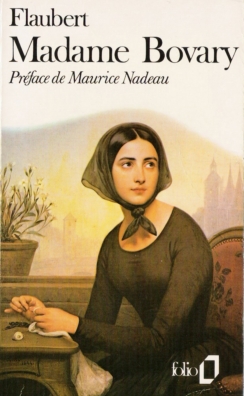

 This novel was another somewhat random find. I was at one of my favorite libraries, browsing through its fairly extensive foreign-books section (this is why it’s a favorite library), and it was propped up on a display stand. I’d never heard of the author, but the endorsement by Zadie Smith was enough for me.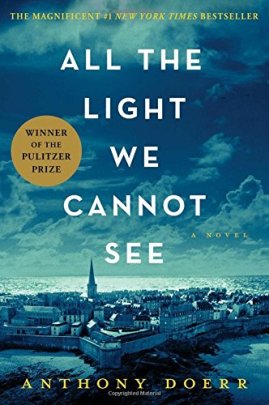


 It happened in May but became more and more official in various stages and still feels rather surreal to me. Especially when I think about how I’d always been a descendant of immigrants – on one side of the family, my ancestors came to the US from Germany four generations ago and on the other side a bit earlier – but am now the immigrant myself, a first-generation one. In hyphenated speak, I was a European-American but now am (also) an American-European.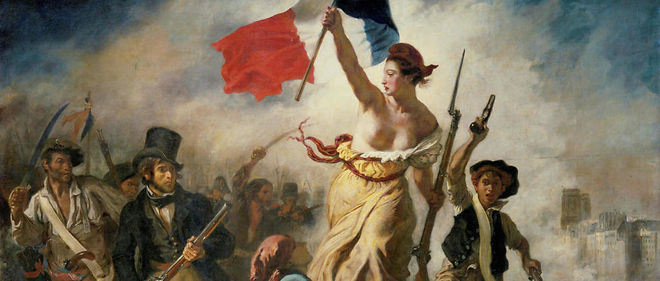

 In Paris, you can get an application by stopping by the naturalization office on Ile de la Cité. I recommend doing this rather than simply downloading it because you can also ask the counter person which documents you – with your particular circumstances – need to provide. Asking in person is really the only way to get an answer, as phone calls tend to not get through.
 Anyone considering applying for the nationality would do well to become a member of a local association, nonprofit or club of some kind years ahead of time. Note that for the naturalization office, simply donating money to a cause does not count as involvement; you need to be an official member of something and have proof of your active involvement in it. You want to show that you’re not just hanging out exclusively with people from your own country, speaking your native language, but are part of the larger society.
 This is a part of the process I was actually looking forward to, as I’d never had my French-language skills formally evaluated (outside of classes that is), not having ever needed to take the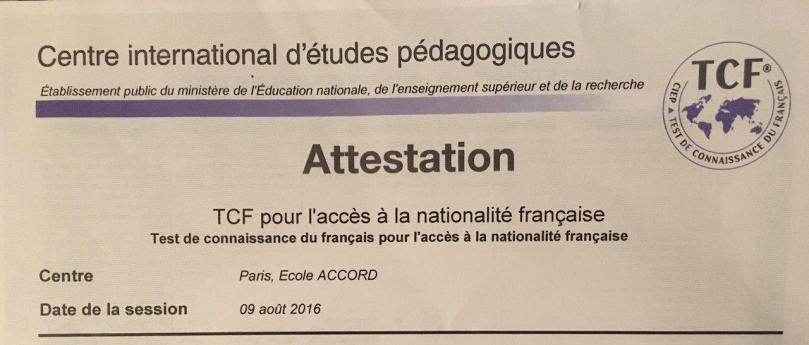
 The application asks for information not just about you but about your parents, siblings, children and even past spouse(s) if you’re divorced or widowed. You’re also supposed to list every single address you’ve ever lived at in your entire life (!) along with dates, and I was amazingly able to do this accurately with the help of my dad, who for some reason had kept a record of all the places our family has lived. The same goes for all the jobs you’ve ever had, though I suppose they don’t place too much importance on the fast-food places you worked at when you were in high school, so there’s no reason to get too stressed. Just use your best judgment as far as what to include, and focus on post university positions.
 When you gain the French nationality, you have the option of changing your name (first and/or last) to something French. Most people opt not to, but you could for example just change a spelling (Mary to Marie) or insert an accent mark (Josephine to Joséphine). Or give yourself the gift of an extra middle name. In France, it’s common to have two or more middle names, so if you have only one, this is your chance to add some extra flair to your life (sadly, I didn’t think of doing this until it was too late). Reflect upon this well ahead of time because you’re supposed to put the new name on your application form. Once the naturalization is complete it becomes much harder to change.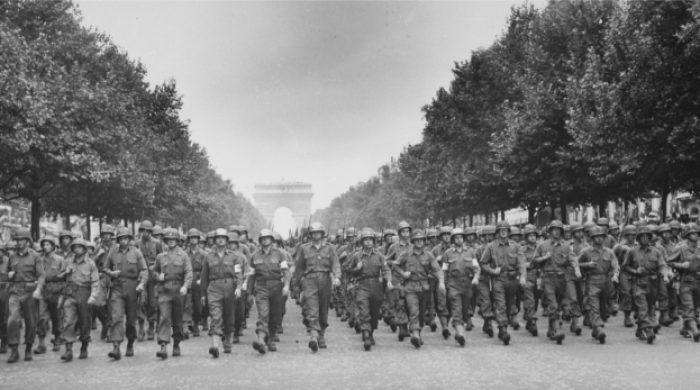

 For many, the naturalization interview is the most dreaded part of the whole process, but if you’re properly prepared it’s not bad at all.
 She then asked me to explain what I knew about the last one, including the related laws and regulations and their dates. As I answered, I noticed her nodding each time I correctly explained one of the key facts. I could almost hear a pinball machine dinging as we went along, pushing my score higher and higher.


 red-violet.com