

As you may have noticed, I really love fusion cuisine and the improbable but delicious flavor pairings that come into being when traditions from different parts of the world are combined. Today’s recipe is one such dish: part Italian, part American and part… Nigerian? Allow me to explain.
This summer, I had plantains on the brain because I’d recently gotten my hands on a really cool plantain cookbook – by Tomi Makanjuola, who runs the blog The Vegan Nigerian – which has over 40 recipes showcasing the underappreciated fruit in almost every kind of dish you can imagine. As I always try to make at least five recipes from every cookbook I acquire, in line with the philosophy behind my cookbook challenge, I set about making some of the dishes right away (my favorites are the beans & plantain pottage and the smoky plantain, mushroom & avocado on toast).
As I began to appreciate the humble plantain more and more, I thought it would be fun to create a plantain recipe of my own for this blog. As I set about reflecting upon savory and sweet combinations not already covered in that cookbook, Hawaiian pizza popped into my mind. Many are the opponents of pineapple on pizza, especially one Italian friend of mine, but I happen to love it. So I thought plantain might work on a pizza too as long as there was also something spicy to balance out the sweetness. After brainstorming a list of likely ingredients, I rolled up my sleeves and got to work.
To be honest, even I was not totally sure if plantain on pizza would work out. But I looooooved it! My mom and dad did, too (I was at their house when I made it). It has smoky, savory notes from the smoked vegan deli meat, crunchy oniony-ness from the red onion, freshness from the cilantro and of course the crispy sweet plantain goodness of the star ingredient. I also love how colorful it is (red, white, yellow, purple, black, green).
So as I was saying, this pizza is a fusion dish – pizza has its origins in Naples but was developed into the dish we know today in early 20th century New York City (listen to this interesting How to Be American podcast episode for more on that) and this particular one has a key ingredient that’s grown in Nigeria, but also other parts of Africa as well as Asia and Latin America. Plantain is therefore not a specifically Nigerian thing, but since a Nigerian cookbook author inspired me to create this dish, I’ve associated it that way in my mind.
If all this has intrigued you and you want to try making it too, read on!
A note about the crust: when I made this pizza, I used an overly complicated homemade pizza dough recipe that I wouldn’t recommend, so I’ll leave it to you to find one you like. It just needs to be thick or firm enough to support the rather hefty plantain slices.
Plantain pizza
Makes an approximately 12-inch (30-cm) pizza
- one thickish (but not deep-dish) pizza crust, purchased or homemade
- 5 to 6 tablespoons pizza sauce (or tomato sauce plus Italian herbs)
- 3/4 cup (75 g) mozzarella-style vegan cheese (optional)
- 2 to 3 vegan deli-style smoked “meat” slices
- 1 to 2 medium-ripe plantains
- 1/2 cup (60 g) red onion
- 1/4 cup (30 g) sliced black olives
- 1/3 cup sliced canned banana, peperoncino or other hot pepper
- small bunch fresh cilantro (coriander)
- 2 tablespoons cornmeal, for pan (or use baking paper)
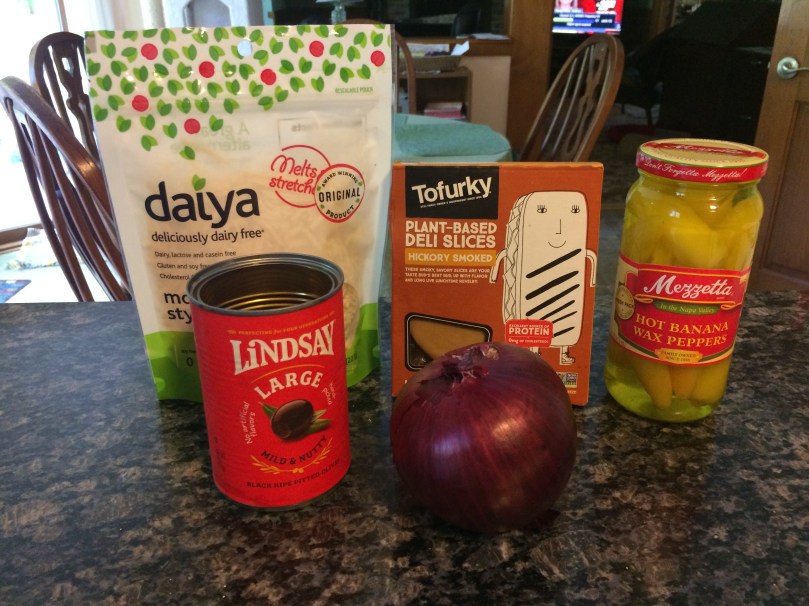


Preheat your oven to 475°F (250°C) and begin by preparing the plantains. Slice each one lengthwise and remove the peel. Slice into rounds of equal thickness, about 1/4th of an inch (5 mm) thick, and sauté on both sides over medium heat until golden brown. It’s important for the plantain to be fully precooked as undercooked plantain can lead to tummyache, and the time it spends in the oven might not be enough.


Sprinkle your baking sheet with the cornmeal to prevent sticking or, alternatively, line with baking paper. Place the dough upon it, rolling it flat if needed – mine was rectangular and measured 10.5 x 12.5 inches (27 x 32 cm) before baking. Spread the pizza sauce on it evenly, using more than the recommended amount if necessary or desired. Cover that with the vegan mozzarella, if using (I recommend Daiya in North America or Violife in Europe). But you can also opt not to use any cheese at all. If you don’t use cheese, a sprinkling of nutritional yeast before or after baking will add a somewhat cheesy flavor.


Cut the smoky vegan deli “meat” slices into squares. Use however much you like.


Slice your red onion (and black olives, if not presliced) and place on top of the pizza.

Finally, slice up the hot peppers and place on top of the pizza in the amount that you like, depending how partial you are. I started with two peppers but ended up adding some more after the pizza came out of the oven as I really loved the combination.
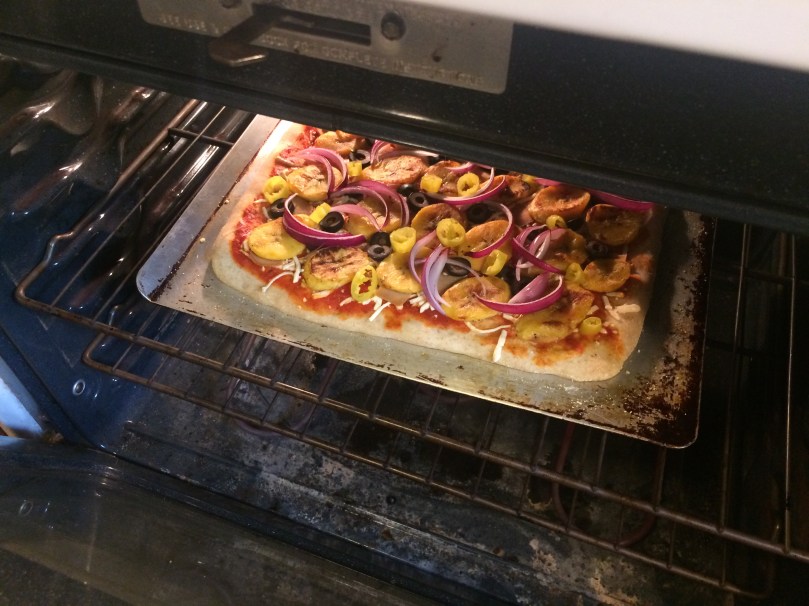
Place in the oven (preheated to 475°F/250°C) and bake for about 10 minutes. Keep an eye on things because baking times can vary quite a bit depending on the thickness of your particular crust. If after 10 minutes it doesn’t seem done, give it some more time.
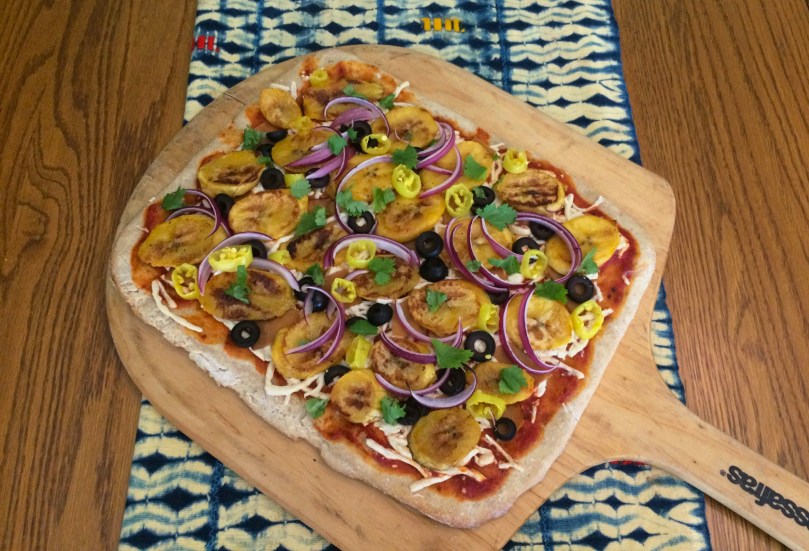
Remove from the oven and garnish with fresh cilantro (coriander) leaves. Your one-of-a-kind plantain pizza is ready! Slice it up and serve it to your hungry guests (…or yourself!).
By the way, what do you think of the tablecloth? An uncle of mine brought it from Liberia as a gift for my parents some years ago, and I thought it would fit well with this recipe’s West African theme.

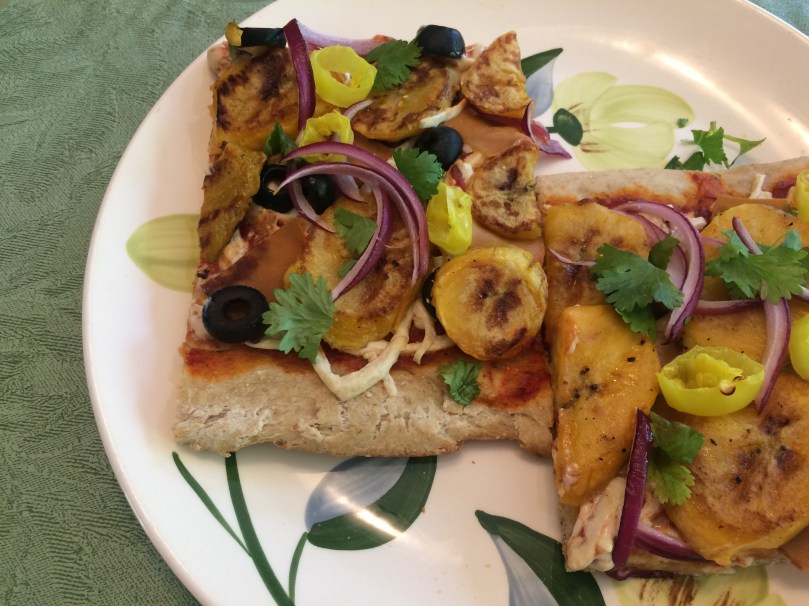
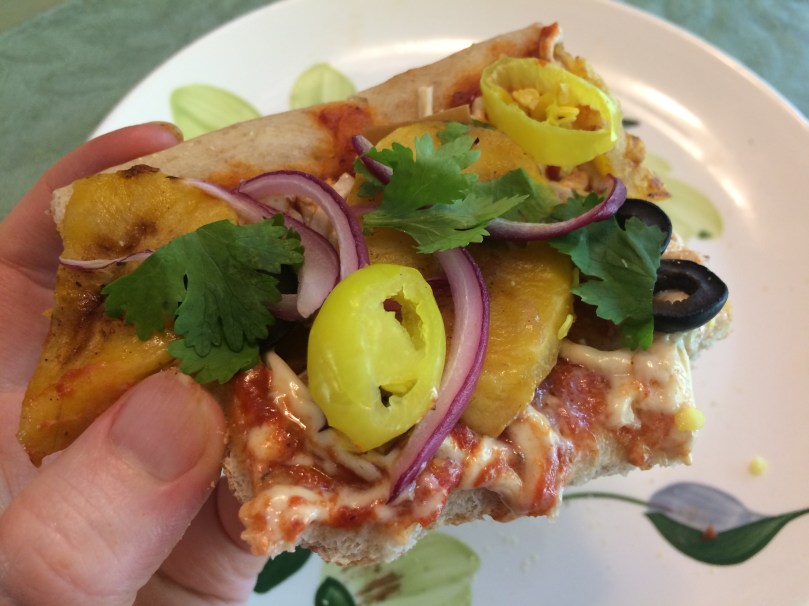
Soooo yummy, if I do say so myself! I want to make it again. 🙂
Where to find ingredients…
Plantains can be found at most supermarkets, but if you don’t find any, look for a Latin-American, African or Asian grocery.
Mozzarella-style vegan cheese is increasingly available at mainstream grocery stores in North America, but organic shops are even more likely to have it. In France, you’ll find it at some organic shops, but for best results check at a vegan food shop first (in Paris: Naturalia Vegan, Mon Epicerie Paris and Aujourd’hui Demain).
Vegan deli “meat” slices will also most likely be found at organic and vegan food shops. In Europe, I recommend the brand Wheaty.












 First, I had the good fortune to be hosted on the Lower East Side of Manhattan by an old friend and former roommate from my undergrad days. Being roommates again was a high point of my stay, reminiscing about the good old days and learning about this new-to-me city from someone who’d already explored it a fair amount.
 But it turned out that while the reputation Paris has is (generally) well deserved, New York City’s isn’t. Throughout my entire stay, I consistently heard Excuse me, Sorry and Thank you, and on several occasions people spontaneously offered me help when I looked like I needed it. On my way into the city, loaded down with a heavy suitcase, I was looking at a flight of subway stairs in dismay when a passing woman volunteered that there was an escalator a bit further down the hall. Another time, I was sitting on a bench applying band-aids to my blistered heels when another passerby offered to supply me with more band-aids should I need them. And on the train to the airport on my last day, my fellow travelers (who could see from my luggage where I was going) helped me figure out what to do when the train service was temporarily halted, without my even having to ask.
 But on several occasions, locals actually did strike up a conversation. One afternoon, taking a break from a street art expedition in Brooklyn, I sat down in a café with a matcha latte and pulled Orlando out of my bag. The middle-aged gentleman working on a laptop at the table next to mine took his headphones off to remark on a coincidence: he was in the middle of writing an opera based on another of Virginia Woolf’s books! We spoke for a few minutes about the smallness of the world and the difficulties of adapting stream-of-consciousness literature to a musical form. When I asked when he expected to finish the piece, he chuckled and said sometime in the next decade. We each went back to our respective occupation and, making a mental note to pay more attention to operas, I wondered if he were somebody famous.


 The district has been home to











 red-violet.com